
From Strategy to Production in Three Months: Grand One and an AI Agent for Quality Assurance
Grand One, Finland's largest digital media competition, processes hundreds of entries every year. Each submission page must be reviewed before jury evaluation. The review checks that the work meets competition rules, fits the declared category, and that technical requirements, content coverage, and link functionality are in order. Previously, checking a single entry could take anywhere from a couple of minutes to two hours, depending on how much investigation and discussion it required. Working through hundreds of entries tied up dozens of person-hours from the organisers each year.

Starting Point
Grand One wanted to explore how AI could be used in their operations. The starting point was not a ready-made solution but an open question: where would AI bring the most value? We went through the organisation's workflows together and identified several opportunities for AI. After evaluation, the first pilot selected was the pre-screening of competition entries before jury evaluation. The selection criteria were clear:
- Clear, measurable goal: time savings are either there or they're not
- High manual workload: volume makes automation worthwhile
- Limited risk: the agent makes no final decisions, a human approves
This is a typical pattern at the start of an agentic project: begin where volume is high, criteria are identifiable, and a human remains the decision-maker. Once the first implementation works, the same logic can be extended to other areas.
This initial mapping phase was decisive. Without a clear picture of opportunities and their priority order, choosing the right first pilot would have been guesswork. The strategic groundwork made the implementation targeted, not experimentation for its own sake.
We had no real idea at the start of where AI could add value for us. Havu helped us figure that out and told us straight where to begin.
Why Automation Alone Wasn't Enough
Competition submission pages are freeform. They can be single landing pages, multi-page sites, videos, or image collections. Rule-based automation, such as "check that the page has heading X", isn't sufficient because content appears in such varied forms.
What was needed was the ability to understand content semantically: does this entry describe its objectives? Are results presented? Is the target audience clear? That kind of assessment requires a language model's ability to interpret freeform text consistently.
This is why the solution was built as an agentic workflow rather than traditional automation. The distinction matters. An agent makes decisions along the way: which checks to run, how to classify findings, and what to escalate to a human. It does not simply execute a fixed sequence of steps.
The Solution in Brief
The agent acts as the first reviewer of competition entries:
- 1.Fetches submission page content (including JavaScript-heavy pages)
- 2.Runs technical checks: page load, link functionality
- 3.Evaluates content coverage: objectives, solution, results, target audience
- 4.Produces a summary and classifies the entry (OK / review / missing info)
- 5.Stores results and surfaces exceptions for organiser review
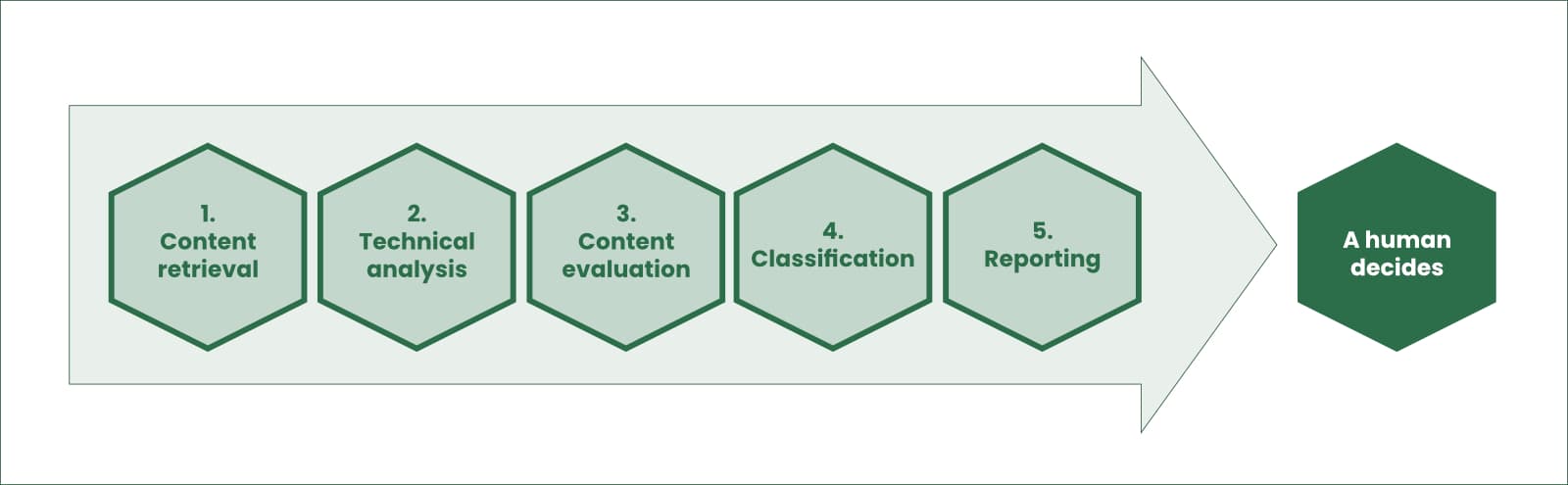
Key principle: the agent makes no final decisions. It screens, justifies its findings, and traces them back to their source. All decisions rest with a human.
Results from the Pilot
The agent was in use for the first time at the 2026 Grand One competition, and it will be used in future years as well. Already on this first run, the change showed in three things:
- Time per entry: previously varied a great deal (from a couple of minutes to two hours), and with the new model dropped by over 60 %.
- Manual steps: from six to one.
- Human role: from performing checks to approving results.
In the pilot, the agent processed over 400 items. As this was the first time AI had been used in the evaluation process, the organisers went through all entries themselves to verify the agent's quality. Even so, dozens of person-hours were saved, and as trust grows the savings will increase further in future competitions. Every finding is justified and traceable to its source, so the organisers could confirm the agent's observations quickly.
The time saved came at exactly the right moment: the 2026 competition schedule was exceptionally tight. Using automation and AI helped stay on schedule, which would otherwise have been difficult.
The most important thing was that the agent justifies each finding and shows where it came from. We can verify the findings quickly and trust them.
How the Project Progressed
The total duration was around three months from strategy discussion to production use. Progress was incremental:
Strategy phase
Review of workflows, identification of multiple AI opportunities, selection of the first pilot using clear criteria.
Scoping
Detailed pilot scope, objectives and criteria, data requirements and privacy compliance mapping, high-level architecture.
Build and test
Modular workflow where each step (fetching, link checking, technical analysis, content analysis) is separate and independently testable. Simple core functionality first, complexity only as needed. Continuous testing throughout development.
Pilot
Over 400 items processed, agent classifications compared against organiser assessments, prompt and criteria refinement.
What Surprised Us
The technical fetching of content turned out to be harder than the AI analysis itself. Submission pages vary greatly in how they are built, from single landing pages to multi-page sites to JavaScript-heavy builds, and extracting consistent content took more fine-tuning than we expected. The analysis itself performed better than we anticipated: the language model reliably identified missing sections and ambiguities when given clear criteria and a reference framework. A single item was also more than one check: each ran through its own evaluation stages in separate sub-workflows, which were then combined into a final assessment for the client to review.
Shifting from doing the checks to approving the results took some getting used to at first. But trust has grown with use. When every finding is justified and traceable, verifying it goes quickly.
How the Collaboration Has Continued
The collaboration has continued after the pilot, working on AI-assisted categorisation and keyword tagging. This work has a significant role in Grand One's upcoming website renewal: enriching previous years' entries makes the archive searchable and comparable, and opens up new possibilities for leveraging the accumulated competition data across years. From an open strategic question to production use and on to data enrichment. The arc has continued, one step at a time.
After the pilot, the collaboration has continued. The next phase will play a major role in our upcoming website renewal.
Technical Implementation in Brief
The solution was built as a modular agentic workflow, where each step (content fetching, technical checking, content analysis) is separate and independently testable. Semantic content evaluation is handled by leading language models. Privacy and compliance were built in from the start. The service runs on Finnish cloud infrastructure, so data stays within Finland. Personal data is automatically removed before storage, the AI processes only content necessary for evaluation, and data is not used for model training.
What Grand One Got
One partner from strategic mapping to production use, without responsibility fragmenting in multiple directions. When the collaboration began, Grand One had no ready view of the role AI could play in their operations. Havu helped clarify that view and identify and prioritise the relevant AI opportunities.
- Strategic partnership: a shared view of what to automate first, and where AI will be applied next.
- Technical implementation: a production-ready, maintainable system that was in use at the 2026 competition and will remain in use going forward.
- Scalable foundation: the same architecture supports further development (e.g. automated feedback, trend analysis, category comparisons).
- Data in Finland: the service runs on Finnish cloud infrastructure, personal data removed before storage.
Where This Approach Fits
Do you regularly process large volumes of similar documents where assessment requires understanding the content? Then the same approach will likely work for you too, especially when you want to keep decision authority with humans while pre-screening can be delegated to an agent.
The same logic applies to application screening, contract review, content quality assurance, and customer feedback classification.
The hardest question is rarely how to automate, but where to start. Identifying the right starting point, where high volume meets clear criteria and limited risk, is a strategic decision. That is where business insight and an understanding of what is technically sensible to build come together.
Interested in learning more?
Contact us to discuss how your company can leverage artificial intelligence.
Frequently asked questions
What did HAVU.AI do for Grand One?
HAVU.AI worked with Grand One, Finland's largest digital media competition, to build an agentic workflow that pre-screens competition entries before jury evaluation. The starting point was an open strategic question – where AI could add the most value – rather than a predefined solution. After mapping the organisation's workflows and identifying several opportunities, the first pilot was selected using three criteria: a clearly measurable goal, high manual workload, and limited risk. The workflow supports the evaluation process and automates pre-screening, but does not make final decisions – a person reviews and approves the results.
What results did Grand One see?
Average processing time per entry dropped by around 60%. Previously, reviewing an individual entry could take anywhere from a couple of minutes to as long as two hours depending on the case. Manual steps in the review process went from six to one, and the organisers' role shifted from performing checks to approving results. The pilot processed over 400 entries at the 2026 Grand One competition. Because it was the first time AI had been used in the evaluation process, the organisers still checked every entry themselves to verify quality. Even so, the change saved dozens of person-hours at a point when the competition's schedule was exceptionally tight.
How long did the project take?
About three months from the first strategy discussion to production use. The work progressed in four stages: a strategy phase to map workflows and select the pilot, scoping to define requirements and privacy compliance, a build-and-test phase using a modular and independently testable workflow, and a pilot that processed 400+ entries while refining the evaluation criteria. The solution was used in production for the 2026 Grand One competition and remains available for future competitions.
Why an agentic workflow rather than plain automation?
Because the content could not be reviewed using fixed rules alone. Competition entries are freeform – single landing pages, multi-page sites, videos, and image collections – so a rule such as “check that the page contains heading X” is not enough. Assessing whether an entry explains its objectives, presents results, or defines its audience clearly requires understanding both content and context. Within predefined boundaries, an agentic workflow can choose appropriate checks, interpret its findings, and classify them for further review rather than sending every entry through exactly the same fixed sequence of rules. Decision authority still remains with people: the workflow explains its findings, traces them back to their sources, and presents the results for human review.
Where else does this approach fit?
The same approach works well in processes where large volumes of similar documents or other content are reviewed regularly and the assessment requires genuine understanding of the content rather than simply following a checklist. The pattern can be applied to areas such as pre-screening grant or other applications, contract review, content quality assurance, and customer feedback classification – situations where decision authority should remain with people, while pre-screening, information gathering, and bounded assessment can be delegated to an agentic workflow. The hard part is rarely the automation itself. It is identifying the right place to start: somewhere with sufficient volume, clear enough evaluation criteria, and limited consequences if the system makes a wrong assessment.